Every Muslim household eventually meets the same frustration: the masjid's Isha time and the phone app disagree by four minutes, the clock disagrees with both, and nobody is sure which to trust. Prayer time accuracy is a solved problem — the astronomy was settled centuries ago — but the setup details trip everyone. This guide walks through the complete accuracy checklist: conventions, adjustments, Qibla, and the devices that keep it all honest.
Understanding Conventions: Why Times Differ at All
Prayer times depend on sun angle definitions, and different scholarly bodies define Fajr and Isha slightly differently — 15, 18, or 19 degrees below the horizon, for example. ISNA (North America), Muslim World League, Umm al-Qura (Makkah), and Egyptian General Authority are the major conventions, and none is "correct" universally; they are regional scholarly choices. The first step to accuracy is knowing which convention your masjid follows and matching it. In North America that is usually ISNA, but some masajid use MWL — ask once, set it everywhere.
The minute adjustment trick
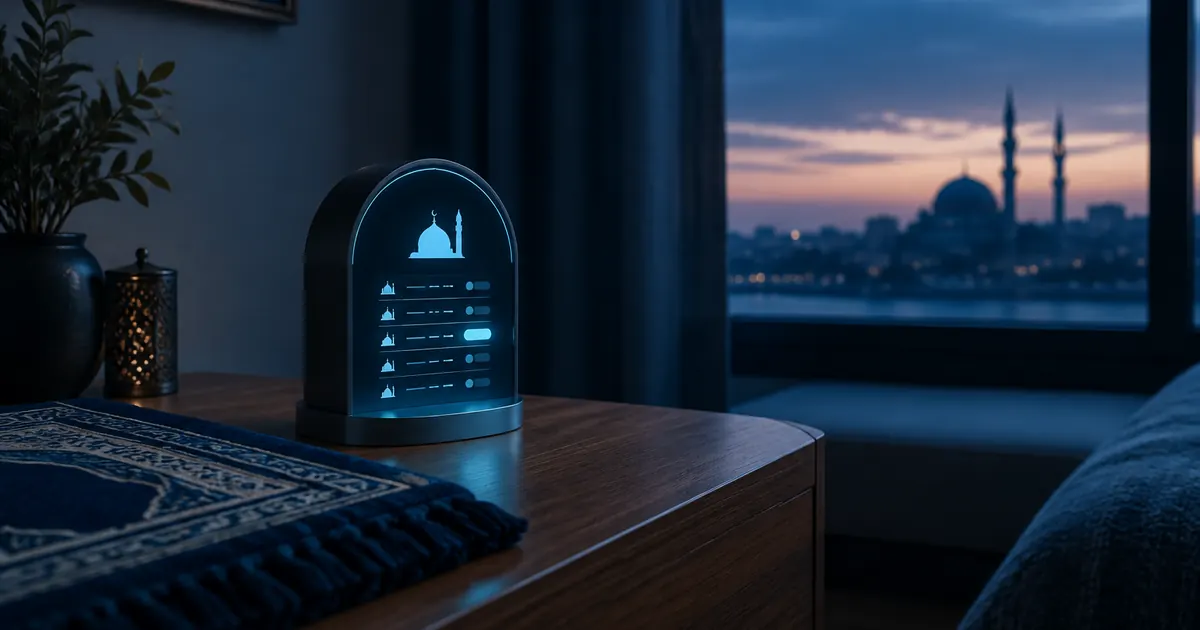
Most quality devices let you add or subtract minutes from calculated times. The most reliable setup we recommend: match your masjid's published timetable by adjusting minutes once, then let the device handle the rest of the year automatically. The Digital Adhan Clock supports both convention selection and minute adjustment, which is why it agrees with the masjid rather than arguing with it.
Daylight Saving: The Silent Killer
Twice a year, clocks without automatic DST adjustment drift an hour and quietly mislead a household until someone notices. Every device we stock auto-adjusts, but if you own anything that does not, calendar the two Sunday mornings and check the times manually. The families who "suddenly missed Fajr" almost always missed the March change.
Qibla: Direction Done Right
Qibla accuracy has two parts: the calculation and the compass. The calculation is trivial — great-circle direction to the Kaaba from your coordinates. The compass is where error creeps in: metal objects, phone cases with magnets, and car dashboards all deflect readings. Calibrate any Qibla device away from metal, and re-calibrate after travel. The Qibla Finder Smartwatch recalibrates in seconds and holds accuracy within about a degree, and the portable prayer mat's compass clasp follows the same rules.
Travel changes more than direction
Remember that travel changes your prayer times too, not just your Qibla. Devices with location auto-update handle it silently; fixed-location devices need your destination entered. Before a trip, check which kind you own — the Solar Power Bank with Qibla compass exists precisely for the off-grid version of this problem.
Building the Redundant System
The households that never miss salah are not the ones with perfect discipline; they are the ones with redundant systems. Our recommended setup: one anchored device — the adhan clock or the Smart Calendar Display in a shared space — plus one personal device, the smartwatch, that travels with you. Set both to the same convention and minute adjustment. When they agree, you trust them; when they disagree, one of them needs recalibration, and you find out before salah, not after.
A Weekly Two-Minute Check
- Compare your clock's next Maghrib against your masjid's published time — they should match within a minute.
- Glance at the Hijri date on any display; a wrong date means a setting drifted.
- Once a month, verify Qibla against a known reference after calibrating away from metal.
Asr and the Madhab Difference
One convention detail worth knowing: Asr time itself differs by madhab — the standard (Shafi'i, Maliki, Hanbali) versus Hanafi calculation can differ by an hour or more in some seasons. Most devices default to the standard and offer Hanafi as a setting. If your community prays Hanafi Asr, set it once on every device and note that your clock will disagree, correctly, with apps that have not been set. This single setting resolves more "my times are wrong" support emails than every other fix combined.
When the Masjid Itself Adjusts
Masajid occasionally adjust their published times for visibility — adding a few minutes of caution around Fajr and Maghrib, for example. Your devices calculate astronomically; the masjid adds pastoral padding. Match your minute adjustment to the masjid's published sheet rather than to raw calculation if praying in congregation is your priority, and let the raw calculation guide home prayers. Both are correct; they are answering slightly different questions.
Two minutes a week buys a year of confidence. And if you are building the system from scratch, the Prayer Time Tools collection holds every device mentioned here, tested with daily use, with free US shipping, tax-free pricing, and 30-day returns behind the setup.